

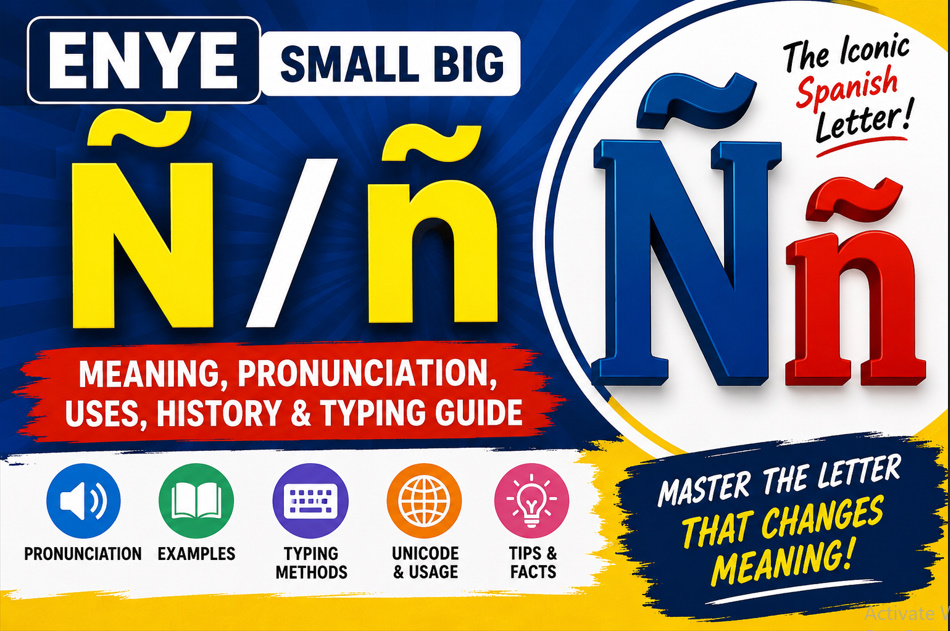
Enye Small Big Letters: Knowledge and History
The Enye Small Big Letters—uppercase Ñ and lowercase ñ—are among the most recognizable symbols of the Spanish language. Their unique appearance immediately distinguishes them from the standard English alphabet, making them an important part of Spanish writing and pronunciation. These letters represent centuries of linguistic development and continue to play a vital role in modern communication.
Although many people recognize the Enye because of its tilde, few understand the fascinating story behind its creation. The Enye is not simply a modified version of the English letter N. Instead, it has its own identity, historical background, pronunciation, and grammatical importance that have been preserved for hundreds of years.
The Birth of Enye Small Big Letters
The story of the Enye begins during the Middle Ages, when handwritten books were copied entirely by scribes. Writing materials such as parchment were expensive, so scribes constantly searched for ways to save space while maintaining readability. One common solution was to write a smaller letter above another letter to indicate duplication.
When two consecutive Ns appeared in a word, scribes often placed a small n above the first one. Over time, the small handwritten character gradually evolved into the curved tilde that now appears above Ñ and ñ. What began as a simple writing shortcut eventually became an official alphabet letter.
Key Points
- Originated in medieval Europe.
- Developed by Spanish scribes.
- Saved writing space.
- Based on double N.
- Tilde replaced the second N.
- Used in handwritten books.
- Became standardized later.
- Preserved through history.
- Represents language evolution.
- Still used today.
Why the Enye Became an Official Letter
As the Spanish language matured, scholars realized that the sound represented by Ñ was different enough to deserve its own alphabet letter. Simply writing the regular N could no longer express the same pronunciation or meaning, making official recognition necessary.
Language authorities eventually accepted Ñ as an independent letter with its own place in dictionaries, grammar books, and educational materials. This decision helped preserve pronunciation accuracy and ensured consistency across Spanish-speaking regions.
Key Points
- Recognized officially.
- Different pronunciation.
- Different spelling.
- Different meanings.
- Used in dictionaries.
- Protected by language rules.
- Important for education.
- Recognized internationally.
- Preserves pronunciation.
- Supports language consistency.
Understanding the Meaning of Enye
The Enye represents much more than a written character. It symbolizes the development of Spanish as a unique language with its own identity. The distinctive tilde makes the letter instantly recognizable and separates it from the ordinary English alphabet.
For millions of native speakers, the Enye carries cultural value as well as linguistic importance. It appears in literature, poetry, education, official documents, family names, and place names, making it an everyday part of life across the Spanish-speaking world.
Key Points
- Symbol of Spanish.
- Represents language identity.
- Used in literature.
- Appears in poetry.
- Found in education.
- Used in official records.
- Important culturally.
- Appears in names.
- Used daily.
- Universally recognized.
How Enye Changed the Spanish Language
Without the Enye, many Spanish words would lose their original pronunciation and become difficult to understand. A single tilde can completely transform the meaning of a word, showing why accurate spelling is so important.
Because of this distinction, students learning Spanish quickly discover that replacing Ñ with N creates entirely different words. This makes the Enye one of the most meaningful letters in the alphabet despite its simple appearance.
Key Points
- Changes pronunciation.
- Changes meanings.
- Prevents confusion.
- Improves spelling.
- Helps communication.
- Important in grammar.
- Supports vocabulary.
- Essential for reading.
- Essential for writing.
- Protects language accuracy.
Enye Small Big Letters in Modern Technology
The digital world has successfully adapted to special alphabet characters through Unicode and international language standards. This allows Ñ and ñ to appear correctly on websites, mobile devices, software, databases, and social media platforms.
Today, almost every operating system includes built-in support for the Enye. Users can type it using keyboard shortcuts, language settings, virtual keyboards, or online character tools without installing additional software.
Key Points
- Unicode compatible.
- Works online.
- Mobile supported.
- Browser supported.
- Database friendly.
- Used in software.
- Easy to type.
- Copy-and-paste friendly.
- Search engine compatible.
- Globally accessible.
Interesting Facts About Enye Small Big Letters
One interesting fact about the Enye is that it is often considered a national symbol of the Spanish language. Many organizations actively protect its proper use because replacing it with N changes pronunciation and sometimes alters legal names or official records.
Another fascinating fact is that the Enye has become widely recognized even by people who do not speak Spanish. It appears on product labels, international maps, educational resources, travel guides, and multilingual websites around the world.
Key Points
- National language symbol.
- Protected by institutions.
- Appears globally.
- Used in education.
- Recognized internationally.
- Important in publishing.
- Found on maps.
- Appears in tourism.
- Used in branding.
- Popular worldwide.
Why Learning Enye Matters Today
Learning the Enye benefits students, teachers, translators, travelers, and professionals who regularly interact with Spanish-speaking communities. Correct pronunciation and spelling improve communication while demonstrating respect for another language and culture.
Knowledge of Enye Small Big Letters also helps developers, writers, and website owners produce multilingual content that remains accurate and professional across different digital platforms.
Key Points
- Helps language learners.
- Improves communication.
- Supports translation.
- Useful for travel.
- Better pronunciation.
- Better spelling.
- Helps developers.
- Helps educators.
- Useful for writers.
- Encourages cultural understanding.
Preserving the Legacy of Enye Small Big Letters
For centuries, the Enye has survived changes in handwriting, printing, and technology without losing its identity. From handwritten manuscripts to smartphones, the letter continues to connect generations of Spanish speakers while preserving the language’s unique sound system.
As digital communication expands across the world, maintaining the correct use of uppercase Ñ and lowercase ñ becomes increasingly important. Their continued use ensures that Spanish remains accurate, expressive, and culturally authentic for future generations.
Key Points
- Rich historical legacy.
- Survived technological change.
- Important cultural symbol.
- Supports language preservation.
- Used worldwide.
- Continues evolving.
- Encourages accurate writing.
- Maintains pronunciation.
- Represents Spanish heritage.
- Inspires future learners.
Conclusion
The Enye Small Big Letters are much more than unusual alphabet characters. Their journey from medieval handwriting to modern digital technology demonstrates how languages evolve while preserving their identity. The uppercase Ñ and lowercase ñ remain essential to Spanish pronunciation, spelling, and cultural expression.
Understanding the knowledge and history behind these remarkable letters helps us appreciate their significance in education, communication, literature, and technology. Whether you are studying Spanish or simply exploring world languages, learning about the Enye offers valuable insight into one of the most distinctive letters ever created.