

What Is the Current Phase of Moon Emoji?
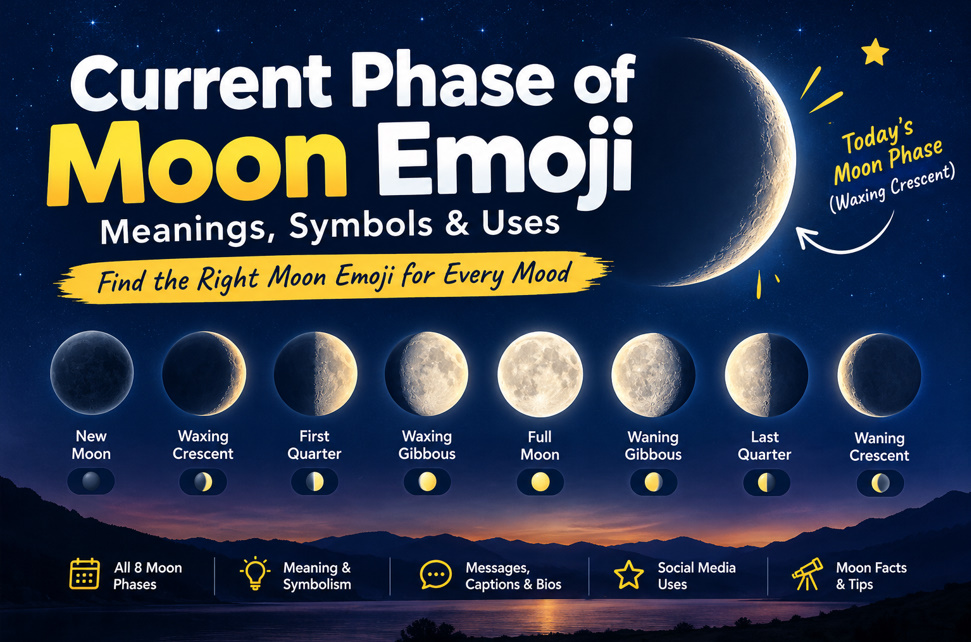
The current phase of moon emoji refers to the moon symbol that best represents the Moon’s appearance during its present lunar phase. Moon emojis are popular in text messages, social media captions, blogs, and astronomy discussions. They help people express nighttime moods, celestial beauty, and lunar observations using simple, recognizable symbols.
There are eight main moon phase emojis, ranging from the new moon 🌑 to the full moon 🌕. Each represents a different stage of the lunar cycle. Choosing the right emoji depends on whether the Moon is growing brighter, becoming less illuminated, or appearing nearly full in the night sky.
- 🌑 New moon
- 🌒 Waxing crescent
- 🌓 First quarter
- 🌔 Waxing gibbous
- 🌕 Full moon
- 🌖 Waning gibbous
- 🌗 Last quarter
- 🌘 Waning crescent
Current Moon Phase Emoji for Today
As of October 14, 2026, the Moon is in the waxing crescent phase in Pakistan. The best matching moon phase emoji is 🌒. During this stage, a small portion of the Moon’s visible surface is illuminated, and the bright section gradually grows as the lunar cycle progresses.
Lunar Calendar for Islamabad, Pakistan
+1
The exact appearance of the Moon depends on your location, viewing time, and local sky conditions. A moon phase emoji is a convenient visual representation rather than a live astronomical measurement. For precise illumination percentages, moonrise times, and phase dates, consult an up-to-date lunar calendar for your city.
- Today’s phase: Waxing crescent
- Matching emoji: 🌒
- Previous major phase: New moon 🌑
- Next major phase: First quarter 🌓
- Next first quarter: October 18, 2026
- Next full moon: October 26, 2026
- Lunar cycle: Approximately 29.5 days
- Best verification method: A local moon phase calendar
Meaning of All Eight Moon Phase Emojis
Moon phase emojis represent the changing appearance of the Moon as it orbits Earth. The eight standard symbols are useful for understanding lunar phases, creating astronomy content, and expressing moods through digital communication. Their official names describe recognizable stages, although the symbols are simplified illustrations rather than exact astronomical images.
Unicode
+1
Understanding the difference between waxing and waning makes these emojis easier to use. Waxing means the visible illuminated portion is increasing, while waning means it is decreasing. These terms describe changes in the Moon’s appearance, not changes in the Moon’s actual size or the amount of sunlight reaching it.
- 🌑 New moon: The Moon appears dark from Earth.
- 🌒 Waxing crescent: A small illuminated crescent grows.
- 🌓 First quarter: Approximately half the visible disk is illuminated.
- 🌔 Waxing gibbous: More than half is illuminated and increasing.
- 🌕 Full moon: The visible disk appears fully illuminated.
- 🌖 Waning gibbous: The illuminated portion begins decreasing.
- 🌗 Last quarter: Approximately half the disk is illuminated.
- 🌘 Waning crescent: A thin illuminated crescent remains.
How to Choose the Correct Moon Emoji
Choosing the right current phase of moon emoji starts with identifying the Moon’s position in its lunar cycle. If the Moon is becoming brighter from night to night, select a waxing emoji. If its illuminated portion is shrinking, choose a waning emoji. A reliable moon phase calendar can help you match the symbol to the correct date.
You can also select a moon emoji based on the message you want to communicate. For example, 🌙 often suggests a peaceful night, 🌕 can represent a bright full-moon evening, and 🌑 may suit a dark-sky or astronomy-themed caption. These everyday interpretations are flexible and depend on context.
- Check the current lunar phase first.
- Use 🌒 for a waxing crescent.
- Choose 🌔 when the Moon is nearly full and growing.
- Use 🌕 for full-moon themes.
- Select 🌖 when the Moon is gradually waning.
- Use 🌘 for a thin waning crescent.
- Add ✨ for a sparkling night-sky effect.
- Combine 🌙 and ⭐ for a simple nighttime caption.
Best Moon Emojis for Social Media and Messaging
Moon emojis are popular on Instagram, WhatsApp, Facebook, TikTok, and other messaging platforms. They can add atmosphere to nighttime photography, travel updates, personal reflections, and short captions. Their visual simplicity makes them easy to recognize, even when a message contains only a few words.
For social media, the best moon emoji depends on the tone of your post. A crescent moon can create a calm, dreamy feeling, while a full moon can complement sky photography or lunar event announcements. Combining moon symbols with stars, clouds, and nighttime imagery helps create a more expressive caption.
- 🌙 Good night and peaceful evening messages
- 🌑 Dark-sky photography captions
- 🌒 New beginnings and growing light
- 🌓 Astronomy facts and lunar updates
- 🌔 Moon-watching reminders
- 🌕 Full-moon photography
- 🌖 Quiet evening reflections
- 🌘 Dreamy night-sky aesthetics
Difference Between Moon Phase Emojis and Moon Face Emojis
Moon phase emojis and moon face emojis look similar, but they serve slightly different purposes. The eight phase symbols, such as 🌒 and 🌕, illustrate the Moon’s changing illumination. Face variations, including 🌚, 🌛, 🌜, and 🌝, add facial expressions that can make a message humorous, playful, or more personal.
Moon face emojis are often used figuratively rather than to describe the actual lunar phase. For example, 🌚 may suggest mischief or an awkward reaction, while 🌝 can convey a playful or exaggerated smile. Their meaning varies between conversations, so the surrounding text and the sender’s intention matter.
Unicode
+1
- 🌑 — New moon phase
- 🌒 — Waxing crescent phase
- 🌕 — Full moon phase
- 🌘 — Waning crescent phase
- 🌚 — New moon face
- 🌛 — First quarter moon face
- 🌜 — Last quarter moon face
- 🌝 — Full moon face
How to Copy and Use Moon Phase Emojis
Copying a moon phase emoji is simple. On a computer, you can select the desired symbol from this guide and copy it using your keyboard shortcuts. On a smartphone, press and hold the symbol if your app supports text selection, or locate the moon category in your device’s emoji keyboard.
You can paste moon emojis into captions, messages, notes, blog posts, and other text fields. Keep in mind that the artwork may look slightly different on Apple, Android, Windows, and other platforms. The underlying emoji character remains the same, but its visual design and shading can vary.
- Select the moon emoji you want.
- Copy it from the text.
- Open your messaging or social media app.
- Paste it into the caption or message.
- Add a short explanation when precision matters.
- Pair it with stars or night-sky symbols.
- Preview the message before publishing.
- Use a lunar calendar for date-specific posts.
Why Moon Phase Emojis Matter for Astronomy and SEO
Moon phase emojis connect everyday digital communication with astronomy, science education, and lunar observation. They can make beginner-friendly explanations easier to scan and help readers recognize concepts such as waxing crescent, first quarter, full moon, and waning crescent. For educational content, pairing an emoji with its correct scientific name improves clarity.
From an SEO perspective, a well-organized article can address related searches such as current moon phase emoji, moon emoji meanings, today’s moon phase, lunar cycle symbols, and moon phase calendar. Clear headings, concise explanations, and relevant terminology also help search engines and AI-powered search systems identify the subject of each section.
- Include the main keyword naturally.
- Explain all eight lunar phases.
- Use descriptive H2 headings.
- Add accurate phase names beside emojis.
- Answer common moon emoji questions directly.
- Keep paragraphs clear and beginner-friendly.
- Update date-specific lunar information regularly.
- Prioritize accuracy over repetitive keywords.